
Exponent Calculator
Enter a base and an exponent to calculate powers like 2^64, 7^-3, 27^(2/3) or 1.05^10. Whole-number powers of whole numbers are computed exactly, even with thousands of digits; negative exponents are shown as exact fractions; fractional exponents are explained as roots. You can also solve for an unknown exponent, such as 2^x = 1000.
- Free to use
- No sign-up
- Runs in your browser
Exponent calculator
Bases can be integers, decimals or fractions (3/4). Exponents can be integers, decimals or fractions (2/3).
Solve for the exponent
Exponents Practice Pack
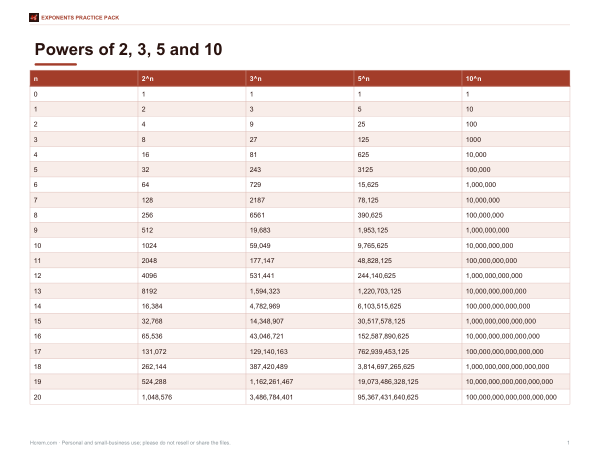
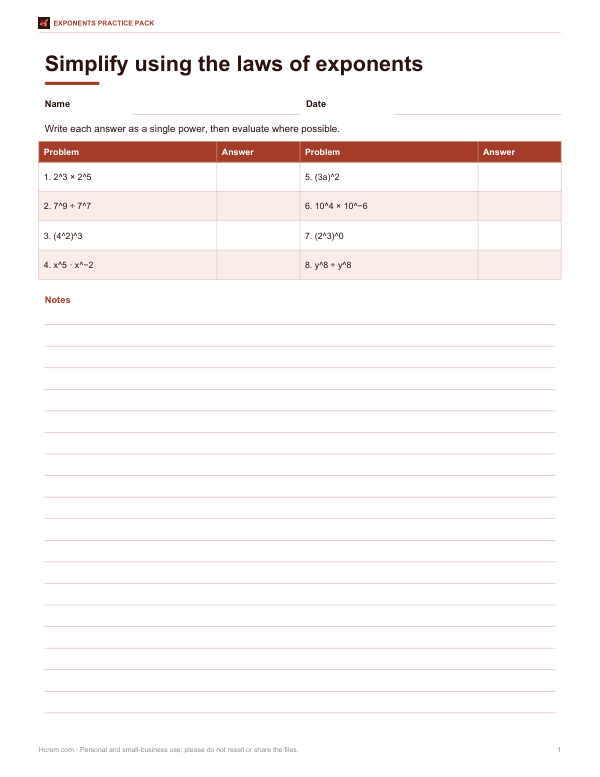
Laws of exponents reference sheet, powers of 2, 3, 5 and 10 tables, and three exponent worksheets (laws, negative and fractional exponents, scientific notation) with answer keys.
- Laws sheet (PDF)
- Powers table (PDF/XLSX)
- Laws worksheet (PDF, DOCX)
- Negative & fractional (PDF, DOCX)
- Scientific notation (PDF, DOCX)
Formats: PDF, DOCX, XLSX. Instant download after payment (link valid 72 hours, up to 5 downloads). AI-assisted: the templates were drafted with AI help and reviewed and laid out before publishing.
$3.00 USD, one-time 5 files · about $0.60 each
- Instant download
- 7-day refund
- Secure checkout by Stripe
7-day money-back guarantee. Full refund within 7 days of purchase, even after you download.
Free sample: Exponent Laws Worksheet (PDF, 98 KB)
Full refund within 7 days — see the refund policy and license.
Free printables
Single sheets you can print right now, no sign-up. The full pack adds every sheet in one download plus the editable files.
 Negative and Fractional Exponents Worksheet
 Printable Scientific Notation Worksheet
What an exponent means
An exponent says how many times to multiply the base by itself: 2^5 = 2 × 2 × 2 × 2 × 2 = 32. The base is 2 and the exponent (or power, or index) is 5. Exponents are a compact way to write very large and very small numbers, and they appear everywhere from compound interest and population growth to computer memory sizes and scientific notation.
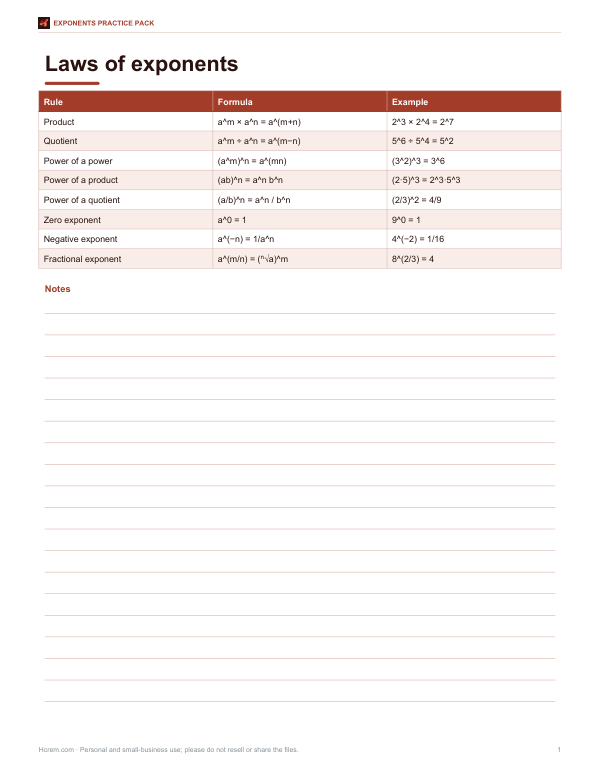
Laws of exponents
| Rule | Formula | Example |
|---|---|---|
| Product | a^m × a^n = a^(m+n) | 2^3 × 2^4 = 2^7 = 128 |
| Quotient | a^m ÷ a^n = a^(m−n) | 5^6 ÷ 5^4 = 5^2 = 25 |
| Power of a power | (a^m)^n = a^(mn) | (3^2)^3 = 3^6 = 729 |
| Power of a product | (ab)^n = a^n b^n | (2·5)^3 = 8 · 125 = 1000 |
| Zero exponent | a^0 = 1 (a ≠ 0) | 7^0 = 1 |
| Negative exponent | a^(−n) = 1 / a^n | 2^(−3) = 1/8 |
| Fractional exponent | a^(m/n) = (ⁿ√a)^m | 27^(2/3) = 3^2 = 9 |
Negative and fractional exponents
A negative exponent means “one over”: 10^−3 = 1/10^3 = 0.001. A fractional exponent means a root: the denominator is the root and the numerator is the power, so 16^(3/4) = (fourth root of 16)^3 = 2^3 = 8. Negative bases with fractional exponents only give real answers when the root is odd — (−8)^(1/3) = −2, but (−4)^(1/2) is not a real number.
How to use the calculator
- Enter the base: a whole number, decimal or fraction such as 3/4.
- Enter the exponent: a whole number, a negative number, a decimal or a fraction such as 2/3.
- Read the exact result for whole-number exponents, the decimal or scientific form, and the digit count.
- For huge results, the full number appears in the box below — scroll or copy it.
- To find an unknown exponent, use “Solve for the exponent” with a base and a result.
Worked examples
- 2^64 = 18,446,744,073,709,551,616 — 20 digits, the number of values a 64-bit computer word can hold.
- 7^−3 = 1/343 ≈ 0.0029155.
- (3/4)^3 = 27/64 = 0.421875.
- 27^(2/3) = 9, because the cube root of 27 is 3 and 3^2 = 9.
- 1.05^10 ≈ 1.6289 — £1,000 at 5% a year grows to about £1,629 in 10 years.
- 2^x = 1000 gives x = log 1000 ÷ log 2 ≈ 9.9658.
Exact results for big numbers
Ordinary calculators and spreadsheets store numbers with about 15–17 significant digits, so 3^50 appears as 7.17897988e+23 and the last digits are lost. This calculator uses arbitrary-precision integers for whole-number powers, so it can show every digit of 3^50 = 717,897,987,691,852,588,770,249 or even 2^10000, which has 3,011 digits. Decimal and fractional exponents are calculated with standard double-precision arithmetic.
Exponents in everyday life
| Where | Example |
|---|---|
| Computing | 1 KiB = 2^10 = 1,024 bytes; 1 GiB = 2^30 bytes |
| Finance | Compound growth: amount = principal × (1 + rate)^years |
| Science | Speed of light ≈ 3 × 10^8 m/s |
| Biology | Bacteria doubling every 20 minutes: 2^3 = 8 times more in an hour |
| Sound | Every 10 dB is 10 times the intensity |
Scientific notation
Scientific notation writes numbers as a × 10ⁿ with 1 ≤ a < 10. The exponent tells you how many places to move the decimal point: 3.2 × 10⁴ = 32,000 and 3.2 × 10⁻⁴ = 0.00032. Multiplying numbers in scientific notation is easy with the product rule: (2 × 10³)(4 × 10⁵) = 8 × 10⁸. Calculators often show it as 8E+08. The exponent calculator shows results larger than a million or smaller than a millionth in this form.
Exponential growth and decay
| Situation | Formula | Example |
|---|---|---|
| Compound interest | A = P(1 + r)ⁿ | $500 at 4% for 15 years ≈ $900.47 |
| Doubling | N = N₀ × 2^(t/T) | Doubling every 3 years: ×16 after 12 years |
| Half-life decay | N = N₀ × (1/2)^(t/T) | After 3 half-lives, 1/8 remains |
| Rule of 72 | Years to double ≈ 72 ÷ rate % | 6% doubles in about 12 years |
Common mistakes
- −3^2 = −9, but (−3)^2 = 9 — the exponent applies only to what is directly before it.
- a^m × a^n is not a^(m×n); add the exponents instead.
- (a + b)^2 is not a^2 + b^2.
- 0^0 is usually defined as 1 in algebra and computing, but is treated as indeterminate in some contexts.
Privacy
All calculations run in your browser; nothing is uploaded.
Frequently asked questions
How do I calculate an exponent?
Multiply the base by itself as many times as the exponent says, or enter it in the calculator.
What is a negative exponent?
The reciprocal of the positive power: a^(−n) = 1/a^n.
What does an exponent of 1/2 mean?
The square root.
What is any number to the power of 0?
1, for any non-zero base.
How many digits does 2^100 have?
31 digits.
How do I solve 2^x = 1000?
x = log(1000) ÷ log(2) ≈ 9.966.
Why is a^0 equal to 1?
Because a^n ÷ a^n = a^(n−n) = a^0, and any non-zero number divided by itself is 1.
What is 10 to the power of −2?
1/100, or 0.01.
Can the calculator show every digit of 2^1000?
Yes, whole-number powers are exact; 2^1000 has 302 digits.
Is anything uploaded?
No, everything runs locally.